
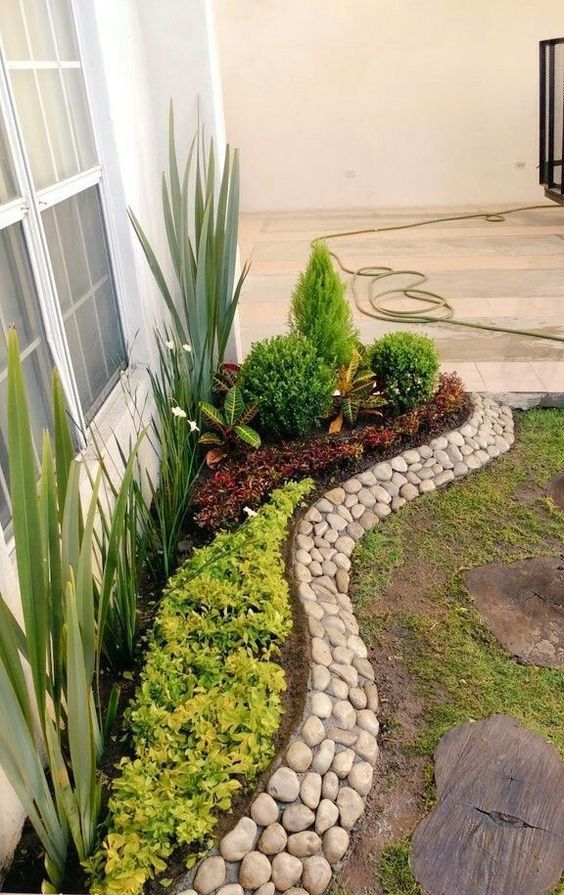
Mulch borders can simplify a landscape by separating planted areas from lawns, paths, walls, and other surfaces. The cleanest designs aren’t necessarily the widest or most decorative. They create a clear edge that can be maintained without repeated trimming, loose mulch spilling everywhere, or grass slowly invading planting beds.
Decide What the Border Needs to Separate
A mulch strip beside turf solves a different problem from one beside a driveway. Lawn edges need resistance to spreading grass, while hardscape edges require control that keeps mulch from washing or being kicked onto the surface.
Consider how the surrounding outdoor features relate to the border. Reviewing garden and outdoor layouts can help show how planting edges interact with patios, recreational areas, lawns, and circulation routes.
A border that looks clean from one viewpoint may still be difficult to maintain if the mower can’t follow it comfortably.
Compare Defined and Natural Edge Styles
Defined edges create a crisp visual division using metal, masonry, timber, or another physical material. Natural edges rely on a shallow cut between the lawn and mulched bed.
Neither approach is automatically better. Formal landscapes often suit a precise line, while relaxed gardens can look better with a gently curved bed edge.
| Border Style | Main Strength | Watch For |
|---|---|---|
| Cut soil edge | Subtle appearance | Needs periodic recutting |
| Metal edging | Thin, crisp division | Installation height matters |
| Brick border | Strong visual detail | Can shift without a base |
| Wide mulch strip | Easier plant separation | Requires enough garden space |
Make Curves Easy to Maintain
Curves should be generous enough for a mower or edging tool to follow smoothly. Tight waves and repeated small bends may look interesting on a drawing but usually create unnecessary work.
For landscapes inspired by more natural surroundings, relaxed garden settings can offer useful visual direction. Broad curves tend to feel more convincing because they resemble larger natural forms rather than decorative squiggles.
Stand back before committing to the line. Viewing the bed from a window or patio often reveals awkward bends that aren’t obvious at ground level.
Use Mulch Depth With Restraint
More mulch isn’t always better. Excess material can bury low plants, migrate into lawns, and pile against trunks or structural surfaces.
The border should remain readable even after normal settling. Maintaining a shallow separation between the mulch surface and neighboring paving can help contain loose material.
On larger sites, property landscape planning can provide broader context for coordinating border locations with maintenance access, circulation, and different outdoor zones.
Why Some Clean Borders Become Messy Quickly
One common mistake is choosing an edge based only on appearance. If grass roots cross underneath, mulch washes over the top, or the mower can’t reach the border, maintenance soon becomes more complicated than before.
Another issue is making beds unnecessarily narrow. Plants eventually outgrow the strip and push into the lawn, forcing constant pruning.
Organic mulch also changes over time. It decomposes, becomes mixed with soil, and may need occasional refreshing. Treat it as a working landscape material rather than a permanent decorative layer.
Frequently Asked Questions
What shape makes a mulch border easiest to mow?
Long, gradual curves and straight runs are generally easiest. Avoid tiny inward corners because mower decks and trimming tools struggle to follow them cleanly.
Does landscape edging stop grass permanently?
Edging can reduce grass intrusion, but it doesn’t remove all maintenance. Rhizomes, surface runners, dropped seed, and soil movement can still allow unwanted growth to cross the boundary.
Should mulch touch a house wall?
Avoid piling mulch excessively against building materials. Keeping the level controlled and maintaining appropriate clearance helps preserve visibility, drainage, and access for inspection.
Design the Edge for Routine Care
A landscape border works best when it makes weekly maintenance simpler, not when it merely creates a sharper photograph on installation day. Use broad lines, choose restraint materials that suit the adjoining surfaces, and leave plants enough room to mature. Once the edge supports mowing, trimming, drainage, and natural plant growth, the garden will keep its organized appearance with far less correction.